
Adolf Hitler, a figure whose name is etched into the annals of history with a blend of infamy and horror, orchestrated one of the 20th century’s most devastating political and military campaigns. His trajectory from a struggling artist to the Führer of Nazi Germany is a complex tapestry woven with personal grievances, political opportunism, and societal vulnerabilities. Understanding his rise and catastrophic fall requires a meticulous examination of the political, economic, and social landscape of his time, as well as the insidious methods he employed to seize and maintain power.
Hitler’s early life is often scrutinized for clues to his later totalitarian tendencies. Born on April 20, 1889, in Braunau am Inn, Austria-Hungary, he was the fourth of six children to Alois Hitler and Klara Pölzl. His childhood was marked by a strained relationship with his authoritarian father and a deep devotion to his mother, whose death from breast cancer in 1907 deeply affected him. These formative years, however, provide mere sketches of the man he would become.
Aspirations and Rejections in Vienna
After his mother’s death, Hitler moved to Vienna, harboring ambitions of becoming an artist. He applied twice to the Academy of Fine Arts Vienna but was rejected on both occasions, with examiners finding his drawings to be “unsatisfactory for a painter.” This period, from 1907 to 1913, was characterized by poverty and a rootless existence. He scraped by painting postcards and small canvases, often staying in homeless shelters. It was during these years that he absorbed the virulent anti-Semitism prevalent in Viennese society, developing much of the racial hatred that would later define his political ideology. He consumed nationalist and anti-Semitic literature, finding an explanation, however twisted, for his own failures and society’s perceived ills.
World War I and the Birth of a Hardened Nationalist
In 1913, Hitler relocated to Munich, Germany, seeking to avoid conscription into the Austro-Hungarian army. However, with the outbreak of World War I in 1914, he volunteered for the Bavarian Army. He served as a dispatch runner on the Western Front, experiencing the brutal realities of trench warfare. He was twice decorated for bravery, including the Iron Cross First Class, a relatively rare honor for a corporal. The war, for Hitler, was a transformative experience. He found purpose and camaraderie, elements largely absent from his civilian life. Germany’s defeat in 1918 and the subsequent Treaty of Versailles, which imposed harsh reparations and territorial losses, fueled his burgeoning nationalism and a bitter sense of betrayal. He felt Germany had been “stabbed in the back” by internal enemies and external powers, a narrative he would later exploit with devastating effectiveness.
Adolf Hitler remains one of history’s most controversial figures, and understanding his impact requires delving into various aspects of his life and ideology. For those interested in exploring more about his early years and the factors that shaped his beliefs, a related article can be found at Hey Did You Know This. This resource provides insights into the lesser-known details of Hitler’s background and the historical context that contributed to his rise to power.
Rise to Power in Post-War Germany
The chaotic aftermath of World War I provided fertile ground for extremist ideologies, and Hitler, now a fervent nationalist, found his calling in politics. Germany was reeling from economic instability, political unrest, and the humiliation of defeat.
Joining and Rebranding the German Workers’ Party
In 1919, Hitler joined the German Workers’ Party (DAP), a small, obscure nationalist and anti-Semitic organization. He quickly displayed an extraordinary talent for oratory, captivating audiences with his passionate speeches, which often denounced the Treaty of Versailles, Jews, and communists. His charisma and skill at whipping up public sentiment were undeniable. He reorganized the party, rebranding it as the National Socialist German Workers’ Party (NSDAP), or Nazi Party. The adoption of the swastika as the party’s emblem, a symbol with ancient Aryan roots, further solidified its nationalist identity.
The Beer Hall Putsch and Its Aftermath
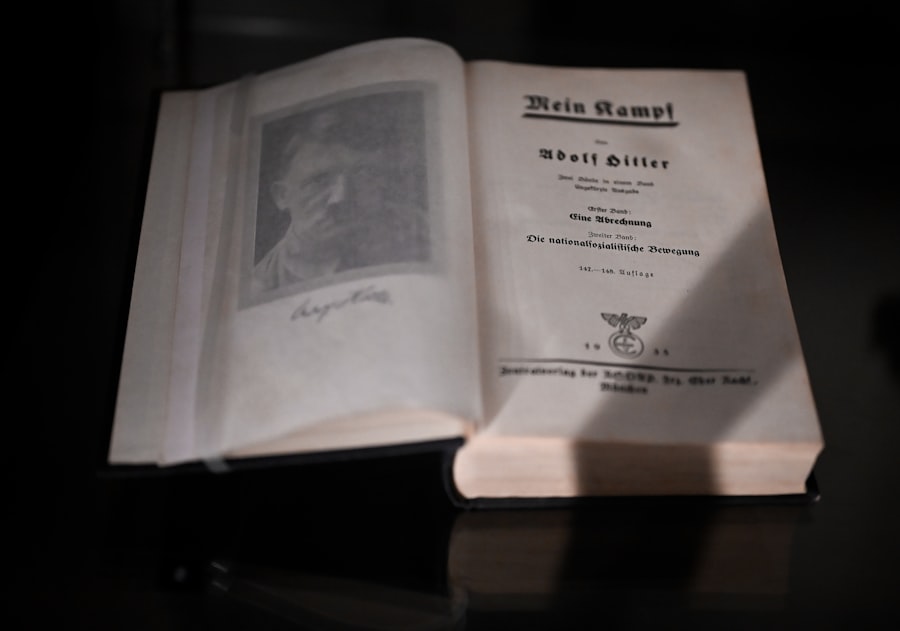
In November 1923, emboldened by the economic crisis and political instability, Hitler attempted to seize power in Bavaria through a coup d’état known as the Beer Hall Putsch. The poorly planned and executed putsch quickly failed, leading to Hitler’s arrest and trial for treason. Though he received a relatively lenient sentence of five years, of which he served only nine months, the trial proved to be a propaganda triumph. He used the courtroom as a platform to articulate his nationalist ideology, gaining national recognition. During his imprisonment at Landsberg Prison, he dictated Mein Kampf (My Struggle), his autobiographical manifesto outlining his political ideology, including his racial theories, anti-Semitism, and expansionist ambitions. This period marked a crucial turning point; Hitler, realizing that power could not be seized by force alone, resolved to achieve it through legal means.
Exploiting the Great Depression and Political Instability
The global economic depression that began in 1929 delivered a crippling blow to Germany’s already fragile economy, leading to mass unemployment and widespread despair. This calamity became the wind in the sails of the Nazi Party. Hitler, with his fiery rhetoric, offered simple, albeit dangerous, solutions to complex problems. He blamed Jews, communists, and the Weimar Republic for Germany’s woes, promising a return to national strength and prosperity. The Nazi Party’s paramilitary wing, the SA (Sturmabteilung), or “brownshirts,” intimidated political opponents and created an atmosphere of fear. As the democratic institutions of the Weimar Republic faltered, support for extremist parties surged. In the July 1932 elections, the Nazis became the largest party in the Reichstag. Through a series of political machinations and miscalculations by conservative elites who believed they could control him, Hitler was appointed Chancellor on January 30, 1933. This moment, dear reader, was the fulcrum upon which European history would pivot towards an abyss.
Consolidation of Power and the Third Reich
Once in power, Hitler moved with ruthless efficiency to dismantle democratic institutions and establish a totalitarian state. The veneer of legality quickly dissipated, revealing the iron fist beneath.
The Reichstag Fire and the Enabling Act
Less than a month after Hitler’s appointment, the Reichstag building, the seat of the German parliament, was set ablaze. While the origins of the fire remain debated, the Nazis swiftly blamed a Dutch communist. Hitler immediately seized the opportunity, convincing President Paul von Hindenburg to issue the Reichstag Fire Decree, which suspended civil liberties and allowed for arbitrary arrests. This was a critical step in establishing a police state. Further solidifying his control, in March 1933, the Reichstag passed the Enabling Act, which effectively granted Hitler dictatorial powers, allowing him to enact laws without parliamentary approval or presidential consent. The façade of democracy was fully shattered, and the “legal revolution” was complete.
Elimination of Opposition and the Night of the Long Knives
With the Enabling Act in place, Hitler systematically eliminated all political opposition. Trade unions were abolished, and all other political parties were outlawed, making the Nazi Party the sole legal political entity in Germany. Independent organizations were gleichgeschaltet (synchronized) with Nazi ideology. In June 1934, Hitler purged the SA leadership, including its long-time leader Ernst Röhm, in what became known as the Night of the Long Knives. This bloody operation, ostensibly to suppress a supposed SA coup, eliminated perceived rivals within the Nazi Party and consolidated Hitler’s control over the military, which had previously viewed the SA with suspicion. When President Hindenburg died in August 1934, Hitler merged the offices of Chancellor and President, declaring himself Führer und Reichskanzler (Leader and Reich Chancellor), effectively becoming the absolute ruler of Germany.
Racial Laws and the Persecution of Jews
The anti-Semitism that had simmered throughout Hitler’s life now became the official policy of the state. The Nuremberg Laws, enacted in 1935, stripped Jews of their German citizenship, forbade marriages and extramarital relations between Jews and Germans, and defined who was considered “Jewish” based on ancestry. This was the first legal step towards the systematic marginalization and dehumanization of Jewish people. Economic persecution, boycotts, and violence against Jews escalated, culminating in Kristallnacht, the “Night of Broken Glass,” in November 1938, when synagogues were burned, Jewish businesses were looted, and thousands of Jews were arrested and sent to concentration camps. These actions served as a chilling prelude to the Holocaust.
World War II and the Holocaust
Hitler’s aggressive foreign policy, driven by his ideology of racial supremacy and Lebensraum (living space) for the German people, inevitably led to war on a scale previously unimaginable.
Expansionist Ambitions and the Road to War
From 1935 onwards, Hitler embarked on a series of provocative moves, meticulously dismantling the restrictions of the Treaty of Versailles and challenging the international order. Germany rearmed, remilitarized the Rhineland, annexed Austria (Anschluss) in 1938, and, with the acquiescence of Britain and France, occupied the Sudetenland region of Czechoslovakia. These actions, met with appeasement rather than firm resistance, only emboldened Hitler. He saw the Western powers as weak and decadent, ripe for conquest. The invasion of Poland on September 1, 1939, officially marked the beginning of World War II.
The Blitzkrieg and Early Victories
Germany’s initial military campaigns, characterized by the devastating “Blitzkrieg” (lightning war) tactic of rapid, coordinated attacks by tanks, aircraft, and infantry, met with stunning success. Poland fell within weeks. In 1940, Germany conquered Denmark, Norway, the Netherlands, Belgium, Luxembourg, and decisively defeated France. Britain, standing alone under Winston Churchill, resisted successfully in the Battle of Britain, forcing Hitler to abandon his invasion plans. However, by 1941, Germany dominated vast swathes of Western Europe. These early victories fueled the cult of Hitler’s infallibility and silenced any remaining dissent within Germany.
Operation Barbarossa and the Eastern Front
In June 1941, in a monumental strategic error, Hitler launched Operation Barbarossa, the invasion of the Soviet Union. This opened up the brutal Eastern Front, a conflict fought with unprecedented savagery and ideological fervor. The initial German advance was swift, but the vastness of the Soviet Union, the harsh Russian winter, and fierce Soviet resistance eventually ground the German war machine to a halt. The Battle of Stalingrad (1942-1943) proved to be the turning point on the Eastern Front, ending with a catastrophic German defeat and signaling the beginning of the end for the Third Reich.
The “Final Solution” and the Holocaust
Parallel to the military conflict, and inextricably linked to Hitler’s core ideology, was the systematic extermination of Europe’s Jews, Roma, homosexuals, disabled people, and political opponents – the Holocaust. The Wannsee Conference in January 1942 formalized the “Final Solution to the Jewish Question,” a bureaucratic plan for genocide. Jews were rounded up from across Europe and transported to extermination camps like Auschwitz-Birkenau, Treblinka, and Sobibór, where millions were murdered in gas chambers. This industrial-scale slaughter, meticulously planned and executed, stands as one of humanity’s darkest chapters, a chilling testament to the depths of human cruelty when fueled by unchecked hatred and absolute power. It is a stark reminder, reader, of where the road paved with prejudice ultimately leads.
Adolf Hitler remains one of history’s most controversial figures, and understanding his rise to power is crucial for comprehending the events of the 20th century. For those interested in exploring this topic further, a related article offers insights into the political strategies that enabled his ascent. You can read more about these strategies in the article here. This examination not only sheds light on Hitler’s tactics but also provides context for the societal conditions that allowed such a regime to flourish.
The Fall of the Third Reich and Hitler’s Demise
| Metric | Data |
|---|---|
| Full Name | Adolf Hitler |
| Date of Birth | April 20, 1889 |
| Place of Birth | Braunau am Inn, Austria-Hungary |
| Date of Death | April 30, 1945 |
| Place of Death | Berlin, Germany |
| Political Party | National Socialist German Workers’ Party (Nazi Party) |
| Position | Chancellor of Germany (1933-1945), Führer of Nazi Germany (1934-1945) |
| Major Events | World War II, Holocaust |
| Military Rank | Führer and Supreme Commander of the Armed Forces |
| Notable Publication | Mein Kampf (My Struggle) |
The tide of war decisively turned against Germany after 1942. The combined might of the Allied powers – the Soviet Union, the United States, and Great Britain – began to squeeze the Third Reich from all sides.
Allied Counteroffensives and the Retreat
Following Stalingrad, the Soviet Union launched relentless counter-offensives, pushing the German army steadily westward. In North Africa, the Allies defeated the Axis forces, followed by the invasion of Italy in 1943. On D-Day, June 6, 1944, the Western Allies launched the largest amphibious invasion in history, landing in Normandy, France, and opening a second front against Germany. The German war machine, stretched thin, low on resources, and facing overwhelming opposition, began a desperate retreat. Hitler, increasingly detached from reality and suffering from deteriorating health, clung to a delusional belief in ultimate victory.
Internal Dissent and Assassination Attempts
As the war turned sour, discontent grew within Germany, particularly among the military elite. Several attempts were made on Hitler’s life, the most notable being the July 20 Plot in 1944, led by Colonel Claus von Stauffenberg. The plot, which involved planting a bomb at Hitler’s headquarters, narrowly failed, leading to brutal reprisals and the execution of thousands of suspected conspirators. These attempts, though unsuccessful, underscored the growing desperation and despair within the regime. Hitler’s paranoia intensified, further isolating him from his inner circle.
The Battle of Berlin and Suicide
In early 1945, Soviet forces encircled Berlin, the capital of the collapsing Third Reich. Hitler, holed up in his Führerbunker beneath the bombed-out chancellery, continued to issue delusional orders to non-existent armies. With the Soviets closing in and the Allied forces from the west advancing rapidly, Hitler accepted the inevitable. He married his long-time companion Eva Braun in the bunker. On April 30, 1945, with the sound of Soviet artillery audible above, Adolf Hitler committed suicide by gunshot, while Braun took cyanide. Their bodies were reportedly burned outside the bunker. Five days later, Germany unconditionally surrendered to the Allies, officially ending the war in Europe. The ‘thousand-year Reich’ had lasted a mere twelve years.
Hitler’s rise and fall stands as a profound historical lesson. It demonstrates how a charismatic demagogue, armed with an ideology of hatred and exploiting societal grievances, can seize power in a democratic state. His story is a stark illustration of the catastrophic consequences of unchecked ambition, racial prejudice, and the failure of international diplomacy to confront aggression. The scars of his reign, particularly the devastation of the Holocaust, serve as a perpetual warning, urging constant vigilance against the forces of hatred and intolerance that, like embers, can reignite if left unattended. Understanding this dark chapter is not merely an academic exercise; it is a moral imperative for humanity.
FAQs
Who was Adolf Hitler?
Adolf Hitler was an Austrian-born German politician who became the leader of the National Socialist German Workers’ Party (Nazi Party). He served as Chancellor of Germany from 1933 to 1945 and Führer from 1934 to 1945.
What role did Adolf Hitler play in World War II?
Adolf Hitler was the primary instigator of World War II. His aggressive expansionist policies and invasions of neighboring countries led to the outbreak of the war in 1939. He aimed to establish a totalitarian regime and expand German territory.
What were the main ideologies promoted by Adolf Hitler?
Hitler promoted ideologies based on nationalism, racial purity, anti-Semitism, and Aryan supremacy. He believed in the superiority of the “Aryan” race and sought to eliminate Jews and other groups he considered undesirable.
What was the impact of Adolf Hitler’s leadership on Germany?
Under Hitler’s leadership, Germany underwent significant militarization and territorial expansion. However, his regime was responsible for widespread atrocities, including the Holocaust, which led to the genocide of six million Jews and millions of other victims.
How did Adolf Hitler’s life end?
Adolf Hitler died by suicide on April 30, 1945, in his bunker in Berlin as Allied forces closed in on the city, marking the imminent end of Nazi Germany in World War II.